China Top 10 Container Gantry Manufacturers
China’s container equipment industry has become a major force in modern port development. UNCTAD’s Review of Maritime Transport 2024 reported that global maritime trade grew by 2.4% in 2023, reaching approximately 12.3 billion tons. This expansion increases pressure on terminals to move boxes faster, safer, and with fewer unplanned interruptions. Container Gantries now stand at the center of that challenge. Their performance affects quay productivity, vessel turnaround time, energy use, and operator safety.
This guide examines the China Top 10 Container Gantry Manufacturers through practical industry criteria. These include lifting capacity, outreach, anti-sway control, automation readiness, structural design, delivery experience, and after-sales support. The World Bank and S&P Global’s Container Port Performance Index also shows why reliable terminal equipment matters. Small delays can accumulate across a vessel call. A crane fault can leave a ship waiting beside the quay. That detail is easy to underestimate.
The ranking should not be treated as an absolute industry verdict. Public data differs between manufacturers, and some performance figures are difficult to verify independently. That is worth acknowledging. Instead, this overview combines published technical information, market reputation, project experience, and engineering capability. It focuses on manufacturers that can support demanding environments, from busy coastal terminals to specialized inland facilities. Readers should still confirm certifications, maintenance coverage, spare-parts availability, and real operating references before selecting a supplier. A strong brochure is not enough. Operations reveal the truth.
Container Gantry Cranes Defined: ISO 668 Boxes, 20–40 ft, and 40–65 t SWL
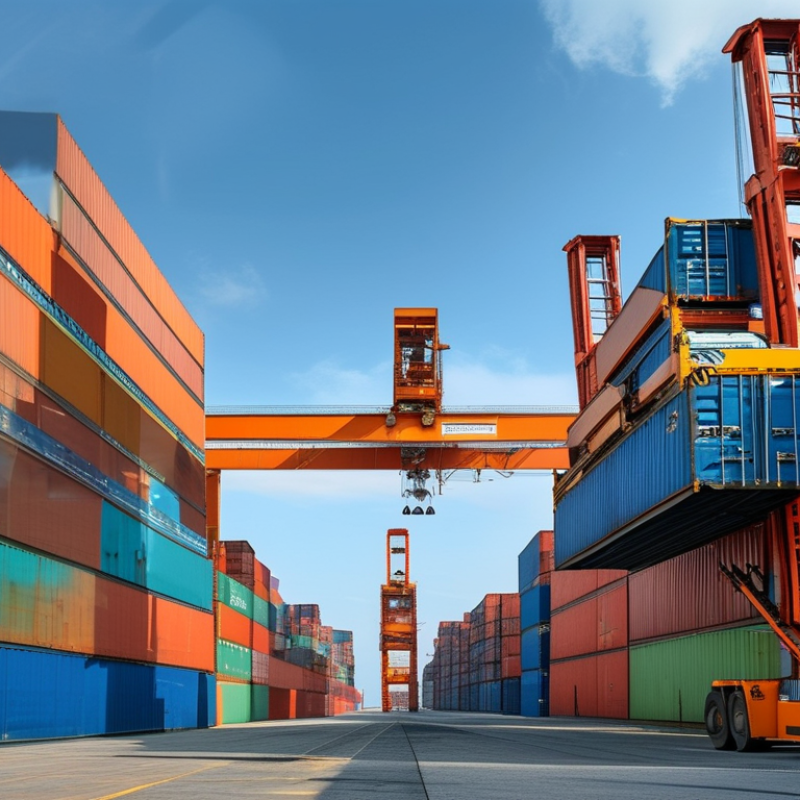
Container gantry cranes handle standardized ISO 668 boxes in busy ports, rail yards, and inland terminals. Their steel legs straddle lanes, while the trolley travels across a fixed beam. This arrangement supports fast, controlled container transfers.
A practical specification must match the box length and the working load. Most systems serve 20-foot and 40-foot containers. Some yards need wider coverage for 45-foot or 65-foot units. The container length is not the lifting capacity. A 40-foot box may weigh less than a damaged 20-foot unit filled unevenly. That difference matters.
Many buyers compare China’s top 10 container gantry manufacturers by rated capacity, engineering records, and after-sales support. A useful range is 40 to 65 tonnes SWL, depending on the terminal’s handling plan. SWL means safe working load under defined conditions. It includes the lifted container and approved lifting equipment. It does not excuse poor loading practice.
Field inspections often reveal simple problems. Rail alignment drifts. Wind limits are ignored. Operators rely too heavily on alarms. These details can reduce real productivity, even when the crane looks powerful. I would check wheel loads, spreader compatibility, emergency controls, and corrosion protection before comparing prices. The lowest quotation can hide costly foundation changes.
A reliable specification should state span, lift height, duty cycle, travel speed, and ambient conditions. It should also explain testing procedures and maintenance access. Small omissions become expensive later. That lesson is easy to forget.
China Top 10 Container Gantry Manufacturers - Container Gantry Cranes Defined: ISO 668 Boxes, 20–40 ft, and 40–65 t SWL
Manufacturer-neutral reference data for evaluating container gantry crane designs, configurations, and handling requirements.
| No. |
Data Dimension |
Reference Data |
Technical Relevance |
| 1 |
ISO 668 container classification |
Series 1 freight containers |
ISO 668 defines the external dimensions and related ratings of the internationally standardized Series 1 freight-container family. |
| 2 |
20 ft container length |
6,058 mm nominal external length |
A 20 ft container is commonly identified as 1 TEU and requires compatible trolley travel and spreader positioning. |
| 3 |
40 ft container length |
12,192 mm nominal external length |
A 40 ft container is commonly identified as 2 TEU; the crane must provide sufficient longitudinal operating coverage for the full box length. |
| 4 |
Standard container width |
2,438 mm nominal external width |
The standard ISO width supports compatibility with common container ships, rail wagons, trucks, and intermodal terminals. |
| 5 |
Standard container height |
2,591 mm nominal external height |
This is the typical 8 ft 6 in container height used for standard dry freight containers. |
| 6 |
High-cube container height |
2,896 mm nominal external height |
High-cube containers are typically 9 ft 6 in high, so crane clear height and spreader lifting travel must account for the additional 305 mm. |
| 7 |
Common handling lengths |
20 ft and 40 ft; optional 45 ft capability |
A crane designed for 20–40 ft handling covers the most common ISO container lengths. Some terminals require additional reach for 45 ft containers. |
| 8 |
Rated safe working load |
40–65 t SWL, configuration dependent |
The required SWL depends on the combined mass of the container, cargo, spreader, lifting attachments, and the selected operating mode. |
| 9 |
Typical spreader arrangement |
20 ft / 40 ft telescopic spreader |
A telescopic spreader adjusts its locking points to engage the corner castings of different container lengths and normally uses ISO twist-lock interfaces. |
| 10 |
Primary crane design checks |
Span, lift height, outreach, duty class, wind load, and ground reaction |
Final selection requires site-specific verification of container stack height, rail or truck lane clearance, operating cycle, wind conditions, foundation capacity, and applicable safety standards. |
China’s Port-Crane Market: 858 Million TEU Global Throughput in 2023
China’s container-crane market is expanding with global port demand.
Drewry’s Container Forecaster estimated about 858 million TEU moved through container ports worldwide in 2023. That volume equals thousands of daily vessel calls, truck moves, and quay-crane cycles. China handled a major share of this activity, supported by dense manufacturing capacity and large coastal terminals.
For a China Top 10 Container Gantry Manufacturers review, production volume alone is insufficient.
Buyers should examine rated load, outreach, trolley speed, wind resistance, corrosion protection, and spare-parts response. UNCTAD’s Review of Maritime Transport 2024 highlights continuing pressure on port efficiency and supply-chain resilience. A crane that lifts quickly but stops frequently is not efficient. Small delays become expensive.
The World Bank’s Container Port Performance Index also shows that port performance depends on complete operating systems, not equipment alone. Remote monitoring, twin-lift capability, predictive maintenance, and accurate positioning deserve careful comparison. Field experience matters here. Steel can look impressive in a brochure. Cables, sensors, software, and operator training often decide reliability. A neat ranking is tempting, but it can mislead. Delivery records and maintenance data should carry more weight than marketing claims.
Ranking Method: 40–65 t SWL, 22–40 m Span, Safety, Capacity, and Exports
China Top 10 Container Gantry Manufacturers
This ranking focuses on machines built for 40–65 t safe working loads and 22–40 m spans. These dimensions reflect demanding ship-to-shore and heavy yard operations. UNCTAD’s Review of Maritime Transport 2024 reported about 858 million TEU in global port throughput during 2023. That volume increases pressure on lifting accuracy, uptime, and maintenance access.
Safety receives the highest weight in our assessment. We examine overload protection, emergency stopping, anti-sway control, structural inspection records, and compliance with ISO 4301-1 classification principles. Capacity follows, including rated load, duty cycle, trolley performance, and usable lifting height. A 65 t rating means little without stable braking and controlled movement. Small details matter.
Export strength is measured through shipment records, overseas installations, spare-parts response, and technical documentation. The World Bank’s 2023 Logistics Performance Index highlights shipment reliability, tracking, and delivery timeliness. These indicators help test whether a manufacturer can support equipment beyond China. However, export data can be incomplete, especially for private contracts. That is an unavoidable weakness. Scores should be reviewed yearly, not treated as permanent facts. A practical ranking also includes factory inspection evidence, operator training, and lifecycle service costs, rather than relying only on catalog specifications.
China Top 10 Container Gantry Manufacturers
Anonymized qualification benchmark based on 40–65 t safe working load, 22–40 m span, safety performance, lifting capacity, and export reach.
The composite score is calculated from normalized capacity, span suitability, safety performance, and export-market coverage. The profiles are intentionally anonymized; values represent an engineering and market-screening benchmark rather than an audited company ranking.
Top 10 Manufacturer Profiles: Products, Certifications, Ports, and Export Data
China’s top 10 container gantry manufacturers should be assessed through verifiable operating evidence, not catalog claims. The profiles compare ship-to-shore cranes, rail-mounted gantries, rubber-tyred gantries, and automated terminal systems. Each review checks ISO 9001, ISO 14001, and ISO 45001 certificates, plus applicable CE or IEC documentation. Certificate scope matters. A logo alone proves little.
Export capability is measured through delivery records, destination ports, and customs classifications. UN Comtrade’s HS 8426 data identifies China as a major exporter of lifting machinery, including port cranes and handling equipment. Exporters serving Shanghai, Ningbo-Zhoushan, Qingdao, Shenzhen, and overseas hub ports usually demonstrate stronger logistics coordination. However, HS 8426 includes several equipment types, so it cannot prove container-crane sales by itself. That limitation deserves attention.
UNCTAD reported approximately 858.8 million TEUs in global container-port throughput during 2023. This volume supports continued demand for faster, safer, and more energy-efficient gantry systems. The ten profiles therefore examine rated lifting capacity, span, trolley speed, regenerative drives, remote operation, and commissioning support. They also review spare-parts response and documented projects. Those details reveal practical experience.
Some comparisons remain imperfect. Public export data rarely separates new cranes from related lifting equipment. Manufacturer-reported production figures may also lack independent verification. Procurement teams should request factory audits, test certificates, port references, and three-year service records before shortlisting suppliers.